"Diamond and Guns" is a 2002 single by The Transplants and includes a memorable, unconventional piano hook and "woo woo" vocal samples.
This song is about Sierra Lione, and the 'blood diamond' mining tragedy there. The same as Kanye West's "Diamonds from Sierra Lione".
"No one lives forever, in fact we all die"
Sunday, January 31, 2010
Saturday, January 30, 2010
Deep Purple - Smoke On The Water
This 1972 song is known for and recognisable by its central theme, a four-note "blues scale" melody harmonised in parallel fourths. The riff, played on a Fender Stratocaster electric guitar by Ritchie Blackmore, is later joined by hi-hat and distorted organ, then drums, then electric bass parts before the start of Ian Gillan's vocal:
"We all came out to Montreux, on the Lake Geneva shoreline
To make records with a mobile, we didn't have much time"
Jon Lord doubles the guitar part on a Hammond B3 organ played through a distorted Marshall amp, creating a tone very similar to that of the guitar. Blackmore uses two fingers to pluck so the pairs of notes can be played exactly simultaneously, to match the organ's timing more closely.
(text from Wikipedia, read the whole article)

Friday, January 29, 2010
Styx - Boat On The River
From the 1979 Cornerstone album, Boat On The River was Styx' biggest European hit. The song features one of the most legendary mandolin solos in rock history, performed by guitarist Tommy Shaw.
In Greek mythology, Styx was a river which formed the bounday between Earth and Underworld.
Take me down to my boat on the river
I need to go down, I need to come down
Take me back to my boat on the river
And I won't cry out any more
In Greek mythology, Styx was a river which formed the bounday between Earth and Underworld.
Take me down to my boat on the river
I need to go down, I need to come down
Take me back to my boat on the river
And I won't cry out any more
Thursday, January 28, 2010
Paul Hardcastle - 19
"19" is a song by British musician Paul Hardcastle released as the first single from his self-titled third studio album Paul Hardcastle (1985). The song features dialogue by television narrator Peter Thomas, and a strong anti-war message.
The track is about America's involvement in the Vietnam War and the effect it had on the soldiers who served. "19" features sampled dialogue and news reports from Vietnam Requiem, an ABC television documentary about the post-traumatic stress disorder suffered by veterans.
The title "19" comes from the documentary's claim that the average age of an American combat soldier in the war was nineteen, as compared to the claim of World War II's 26. This claim has since been disputed. Undisputed statistics do not exist, although Southeast Asia Combat Area Casualties Current File (CACCF) shows a large number of deaths (38%) were ages 19 or 20.
The song also comments that while the tour of duty was longer during WWII, soldiers in Vietnam were subject to hostile enemy fire almost every day.
Wednesday, January 27, 2010
America - Horse With No Name
America's self-titled debut album was released initially in Europe with only moderate success and without the song "A Horse with No Name". Trying to find a song that would be popular in both the United States and Europe, "A Horse with No Name" was originally called "Desert Song".
Despite (or perhaps, because of) the song's being banned by some U.S. radio stations (including one in Kansas City) because of supposed drug references the song ascended to number one on the U.S. Billboard Hot 100 and the album quickly scored platinum.
The song has also been ridiculed for its banal, oddly phrased lyrics, including "The heat was hot"; "There were plants, and birds, and rocks, and things"; and "Cause there ain't no-one for to give you no pain."
Tuesday, January 26, 2010
Monday, January 25, 2010
Dio - Holy Diver
Dio is Ronnie James Dio, the replacement vocalist for Ozzy Osbourne in Black Sabbath. His solo career was far less successful than Ozzy's, and there is a mutual hatred between the two.
This song is about Satan, and his descent to Hell (his "dive"). The lyrics deal specifically with Revelations 12:9 where Satan was cast to the earth. The tiger is symbolic of the wild beast that comes out of the sea, as mentioned in Revelations 13:1.
There are two characters in this song: the tiger and the holy diver. The tiger is the Sun God ("the cat in the blue is coming after you, holy diver") and the holy diver is an ordinary person who sees the hypocrisy of religion ("the velvet lies") and finds himself lost ("in the midnight sea" or darkness). There are "shiny diamonds" or stars as if "the eyes of the cat" were in both "the black and blue" or night sky as well as day.
The impulse here is to get away from religion ("something is coming for you") but still seek that guiding light ("race for the morning"). The paradox is quickly realized ("you can hide in the Sun until you see the light"): that which he is running from he is also searching for. So, the conclusion is to "ride," "jump on," mount the tiger, taking personal control of his beliefs and rejecting organized religion.
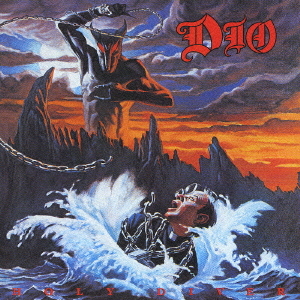 Generally speaking, things are not always what they seem. (Is the demon on the cover drowning the priest, or the priest drowning the demon?) The tiger looks dirty but there is nothing wrong with him. You can feel his love, but don't let your guard down. Finding balance is a recurring theme in Dio's works.
This song is about Satan, and his descent to Hell (his "dive"). The lyrics deal specifically with Revelations 12:9 where Satan was cast to the earth. The tiger is symbolic of the wild beast that comes out of the sea, as mentioned in Revelations 13:1.
There are two characters in this song: the tiger and the holy diver. The tiger is the Sun God ("the cat in the blue is coming after you, holy diver") and the holy diver is an ordinary person who sees the hypocrisy of religion ("the velvet lies") and finds himself lost ("in the midnight sea" or darkness). There are "shiny diamonds" or stars as if "the eyes of the cat" were in both "the black and blue" or night sky as well as day.
The impulse here is to get away from religion ("something is coming for you") but still seek that guiding light ("race for the morning"). The paradox is quickly realized ("you can hide in the Sun until you see the light"): that which he is running from he is also searching for. So, the conclusion is to "ride," "jump on," mount the tiger, taking personal control of his beliefs and rejecting organized religion.
Generally speaking, things are not always what they seem. (Is the demon on the cover drowning the priest, or the priest drowning the demon?) The tiger looks dirty but there is nothing wrong with him. You can feel his love, but don't let your guard down. Finding balance is a recurring theme in Dio's works.
Subscribe to:
Posts (Atom)